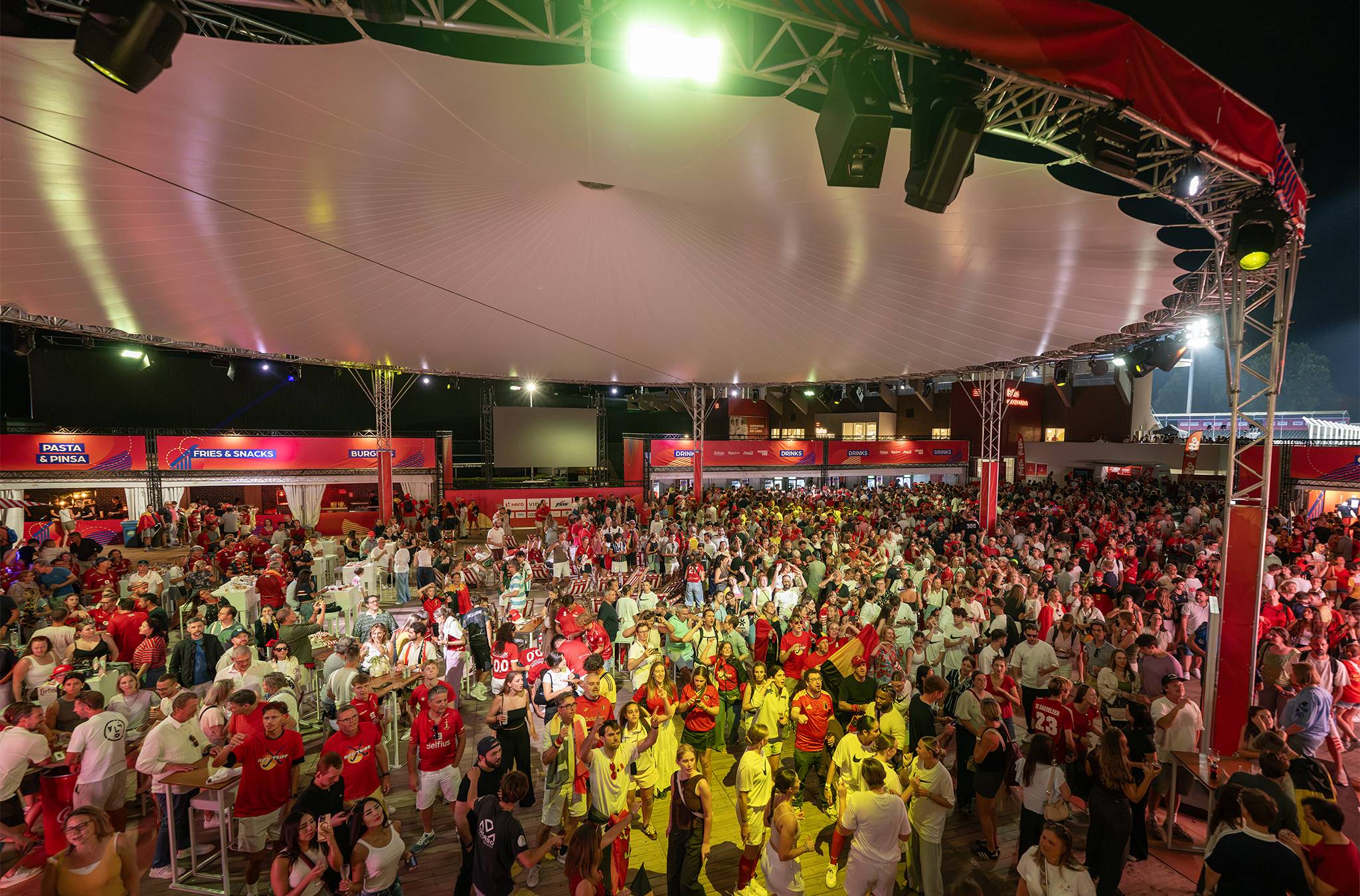
Scaling festival bars: what changes when you grow from 2,000 to 10,000 visitors?

When scaling festival bars, start with the payment step, then the network and overview.
At a small edition, one volunteer with a cash box solves a lot. With five times the crowd, you have more bars, more shifts and more money changing hands.
Our advice: scale per bar and per peak, not per festival. Rent extra devices for your busiest hours instead of buying everything outright.
- The queue at the token or top-up desk grows fastest: bring payment to the bar.
- More bars on a bigger site need a network with 4G and offline mode.
- Crew, partners and vendors each need their own credit and report.
- Live figures per bar let you adjust while the festival is running.
What breaks first when scaling festival bars?
The payment step. With tokens or a top-up desk, every visitor queues twice: first at the desk, then at the bar.
At a small edition that's manageable. As your festival grows, that first queue grows with it, and it's the one you notice first.
Couleur Café brought payment to the bar.
Bancontact Pay went from a few bars to all 21 bars there, which cut the pressure on the central voucher desks, says the Couleur Café customer story.
In 30 minutes we'll show you how to scale bars, devices and credit from one edition to the next.
What changes at the bar at a bigger edition?
Almost everything you did by hand moves into the system. Here's how that looks per part:
| Part | Small edition | Bigger edition |
|---|---|---|
| Payment | Cash or tokens at one desk | Bank card at every bar |
| Cash | A cash box per bar | One central top-up point |
| Network | The venue's wifi | Wifi, 4G and offline buffer |
| Crew drinks | Paper vouchers | Internal credit on a card |
| Overview | Counting afterwards | Live per bar and device |
Each row is a choice you can make per edition. You don't have to change everything in one year.
How many extra terminals do you need as you grow?
Count per bar and per peak hour. A bar that fills up between two sets needs more devices then than at a quiet moment.
- Mobile terminals: your bar crew take payment along the queue, and you move them to where it's busy.
- Terminals in a stand: for fixed points, on mains power, without battery worries.
- Charging: a mobile terminal lasts up to 14 hours and a charging case holds up to 20 at once.
You don't have to buy those devices.
Beyond Ordering puts the hardware together per situation, with no fixed package, see the hardware page.
What do you do about the network on a bigger site?
Build in a fallback. More bars sit further apart, and not every spot has equally good wifi.
- 4G as a safety net: every terminal has a SIM card and switches over when the wifi drops.
- Working offline: the terminals buffer sales until the network is back.
- Network plan: Starlink, 5G or fixed internet, matched to your site, see wifi at your event.
At Lokerse Feesten, every top-up and purchase is written straight to the cashless card.
That keeps payments working when the network or the power goes down, as the customer story explains.
How do you keep crew, partners and vendors apart?
With their own credit and their own report per group. That's the point where paper vouchers stop working.
- Crew: internal credit on a card, which doesn't count as revenue.
- Partners and sponsors: a pre-agreed credit or a QR voucher.
- External vendors: their own revenue per sales point, so the settlement adds up, see splitting revenue between bar partners.
Do you run your own crew platform?
At Lokerse Feesten, that platform uses the open API to send credit every day to the cards of whoever works that day.
When do you need support on site?
As soon as your core team no longer has time to watch the devices. Beyond Ordering works with three levels, see the service page:
- Do it yourself: you get pre-configured hardware and run it yourself, with support via WhatsApp.
- Start-up: the team installs everything and guides your crew through the start.
- Full-service: the team is on site for the whole event and takes over the technical side.
Live 24/7 WhatsApp support is included as standard.
How it all fits together is on our cashless payment system for festivals page.
The greatest asset of Beyond Ordering is its immense flexibility. We maintain stable operations in our music club, but for our summer events, we scale up in a heartbeat by renting exactly the extra hardware we need. No unnecessary overkill or costs in the winter, just maximum capacity and speed when we're going all out outdoors in the summer.
In practice: Muziekclub N9
The event: a music club with its own concert hall, which runs large outdoor summer events such as Huymanshoeve and the city festival Helden in het Park.
The challenge: in summer, visitor numbers and the pressure on the bars rise sharply. Permanently buying a large fleet of terminals would be financially inefficient.
Too little hardware, on the other hand, means long queues.
The setup: a fixed set of terminals in the club, plus extra mobile terminals N9 rents for the outdoor terraces and festival bars.
Deposits and cash cards are added for the summer, with every price list in one back office.
The result: the extra terminals absorb the peaks, with shorter queues and higher bar revenue.
Volunteers use the same software in winter and summer.
Also with Beyond Ordering: Lokerse Feesten, Couleur Café, Student Kick-off Ghent and Bollekesfeest.
Frequently asked questions
From how many visitors does cashless pay off at a festival?
There's no fixed line. It depends on how much each bar sells and how much cash you want on your site.
Do I need to buy terminals as my festival grows?
No. You can rent extra devices per edition, as Muziekclub N9 does for its summer events.
Can the payment system link to my ticketing?
Yes. Lokerse Feesten visitors link their Tickoweb pre-sales voucher to their cashless card, see the integrations.
What changes when my festival runs over several days?
You plan charging, restocking and closing per day. Follow sales per bar live, so you know what to add the next day.
Plan your next edition bar by bar
Take the figures from your last edition and mark the busiest hour per bar. That's where you start scaling.
Want to see what that looks like for your festival? We'll work it out together in a 30-minute demo. Rather ask a question first? Get in touch.
Your bar, ready for the next edition
In 30 minutes we'll show you how to scale bars, devices and credit from one edition to the next.
Read more stories from our blog
Opening a summer bar: what do you sort out first?
Opening a summer bar starts in winter: first the site, then the KBO, FAVV, a drinks licence and a till that takes both cash and card.

Single-use cup ban in Belgium: which cups are still allowed in 2026?
The single-use cup ban in Belgium: what's still allowed at events, in your café and for takeaway? Flemish, federal and EU rules side by side.

Several bars in one venue: how do you track stock and sales per bar?
Running several bars in one venue? Track stock and sales per bar: each bar its own sales point, log transfers and count at closing against the report.