Festival bar staff planning: how many people do you need, and when?
Do your festival bar staff planning per hour, not per day.
How many people you need follows from your sales per bar and per hour.
If you have last edition's figures, you plan for the peak hour instead of on gut feeling.
Our advice: give every person one role and put most people on the peak hour. Keep a small reserve team ready for the busiest bar.
- Plan per bar and per hour, based on last edition's sales.
- Give every person one role: pouring, payment, cups or restocking.
- Put most people on the peak hour, not across the whole evening.
- Send a reserve team to whichever bar has the growing queue.
- Follow each bar live during the festival, and adjust.
How many staff do you need at a festival bar?
As many as your busiest hour asks for.
There's no fixed standard: it depends on your crowd, your menu and how fast people pay.
Work it out like this:
- Sales per hour: take the number of sales per hour for each bar from last edition.
- Capacity per till: check what one till handled at its busiest.
- Number of tills: divide the first figure by the second.
- People per till: put enough pourers next to each till, plus one person for cups and restocking.
Running a first edition? Then you don't have those figures.
Start with your most cautious estimate plus a reserve team, and measure everything for next year.
How to read those figures is in using your festival sales data.
In 30 minutes we'll show you how to follow sales per bar and per hour, so you know where your team is needed.
Which roles do you hand out at the bar?
One role per person.
Someone who pours and takes payment does both more slowly, and when the till is short, nobody knows who was in the drawer.
| Role | Task | When it matters most |
|---|---|---|
| Pourer | Getting beer and soft drinks ready | Peak hour, between two acts |
| Till | Entering orders and taking payment | Every minute the bar is open |
| Cups | Deposits, returns and washing | End of the evening |
| Restocking | Kegs, fridges and stock | Before and after the peak |
| Bar lead | Opening the till, counting, adjusting | Opening and closing |
The bar lead is also the one who counts the till at closing. How that works is in the cash count after an event.
How does festival bar staff planning work around the peak hour?
Set your shifts so a handover never falls at the busiest moment.
- Peak hour fully staffed: everyone you have is there for the busiest hour of the evening.
- Handover outside the peak: a new team starts before or after the rush, not in it.
- Overlap for the briefing: let the new team work alongside the old one briefly, so the till and the stock change hands cleanly.
- Central reserve: a few people without a fixed bar, called in by the bar lead.
Queues between two acts are the classic complaint.
What else you can do about them is in long queues at the bar.
Organising a festival for 35,000 students in the centre of Ghent made me hesitant about going cashless. But thanks to Beyond Ordering’s involvement and guidance, the switch went remarkably smoothly. They never push anything, they think along with our organisation, and they’re always available, before, during and after the event. Two years in, we’re still just as happy: a huge asset for our F&B operation and for our visitors.

Who do you use: volunteers, students or regular staff?
Usually a mix. Each group has its own rules.
- Volunteers: often through an association running a bar. How to prepare them is in volunteers at your festival bar.
- Student workers: a student gets a package of 650 hours per calendar year at reduced social contributions, according to Student at work. Above that, normal contributions apply.
- Association work: in the sociocultural or sports sector, a student should stay under 190 hours a year in that scheme. If they did too much association work, the extra hours come off their student hours.
How do you get bar staff up to speed quickly?
With a short briefing at the bar itself, and a till that only asks one thing of them.
A good briefing is short and covers three things:
- The price list: what's on the till, and which button does what.
- The age rules: who may drink what, and when to ask for proof. See age checks at the festival bar.
- The money: who manages the drawer and when cash is skimmed.
Onboarding student workers on Beyond Ordering's terminals takes less than 5 minutes, says the pop-ups and catering page.
Beyond Ordering gives your team a comprehensive briefing before you go live, says the service page.
How do you adjust during the festival?
By watching live where it's busy, and moving people.
- Per bar and per device: the monitoring app shows the activity and performance of your team and hardware, per location and per function.
- Crew planning linked: with the Eventication integration, you assign cashless budgets automatically, matched to each person's role or scheduled shift. More on crew drinks in crew and artist drinks.
That's how Beyond Ordering's cashless payment system for festivals works on a full night.
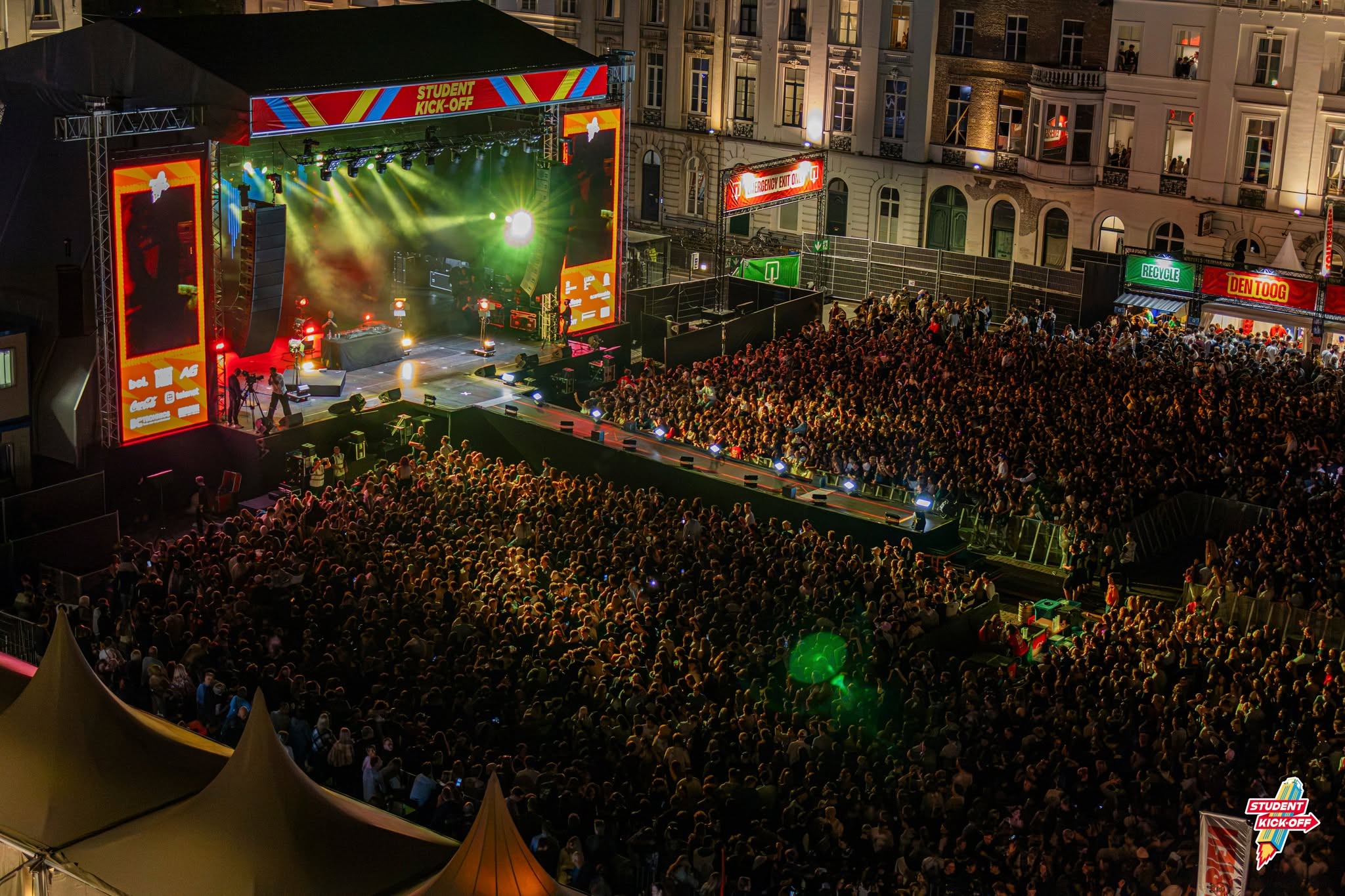
In practice: Student Kick-off Ghent
The event: the largest student festival in Flanders, with 35,000 students on the Sint-Pietersplein. Between 8 pm and 12:30 am, every bar runs at full capacity.
The challenge: the organisation has only one chance to make its revenue. A slow or glitchy payment system isn't an option.
The setup: 105 all-in-one terminals, 85 mobile and 20 fixed. The F&B core team tracked the performance of every device and every staff member per bar on the real-time dashboard.
The result: students paid quickly, even at peak hours. When drinks or cups threatened to run out anywhere, the organisation could restock straight away. Read the full Student Kick-off story.
Also with Beyond Ordering: Couleur Café, Lokerse Feesten, Bollekesfeest and Muziekclub N9.
Frequently asked questions
What do you do when one bar is understaffed?
Send your reserve team and put one extra person on the till, because that's where the queue starts. If it stays busy, move someone from the quietest bar.
How long is a shift at a festival bar?
That's your call, within the rules for employees and students. What matters more is that no handover falls on the peak hour.
Do bar staff get drinks from the organiser?
You decide. At the Student Kick-off, drinks on internal credit didn't end up in the books as revenue.
When do you start planning?
As soon as your site plan and your bars are fixed. Afterwards, compare your plan with sales per hour, see evaluating your festival.
Fix your peak hour before planning starts
Look up the busiest hour of each bar from last edition and assign your people there first, role by role.
Want to see how to follow sales per bar and per hour? We'll show you in a 30-minute demo. Rather ask a question first? Get in touch.
Your bars staffed at peak hour
In 30 minutes we'll show you how to follow sales per bar and per hour, so you know where your team is needed.
Read more stories from our blog
Opening a summer bar: what do you sort out first?
Opening a summer bar starts in winter: first the site, then the KBO, FAVV, a drinks licence and a till that takes both cash and card.

Single-use cup ban in Belgium: which cups are still allowed in 2026?
The single-use cup ban in Belgium: what's still allowed at events, in your café and for takeaway? Flemish, federal and EU rules side by side.

Several bars in one venue: how do you track stock and sales per bar?
Running several bars in one venue? Track stock and sales per bar: each bar its own sales point, log transfers and count at closing against the report.