What are card payment fees for merchants in Belgium?

Status on 17 November 2026: the rates below come from the own pages of KBC (Worldline), Mollie and SumUp, checked on 17 November 2026. They change regularly: check them before you sign.
Merchants pay a transaction fee per card payment, often plus a terminal and plan.
For Bancontact that's sometimes a fixed fee per payment, sometimes a percentage of the amount.
Our advice: work with your own average bill. A fixed fee pays off on large bills, a percentage on small ones.
- A card payment costs you three things: the terminal, the transaction fee and often a monthly plan.
- Some providers charge a fixed fee for Bancontact; credit cards almost always cost a percentage.
- Business and foreign cards usually cost more.
- You can't pass the fee on to your customer.
- Your average bill decides which formula comes out lowest.
How much are card payment fees for merchants on Bancontact?
Anywhere from a few cents to over one euro per payment, depending on your formula and the amount.
Three public examples from today:
- KBC, with a Worldline terminal: a fixed fee per payment for Bancontact and Belgian debit cards.
- Mollie: a percentage for local debit cards, or a fixed fee plus a smaller percentage on a monthly plan.
- SumUp: one percentage for all in-person card payments, Bancontact included.
The exact figures are in the comparison below, with their source.
In 30 minutes we'll show you how card, cash and QR end up in one report, with the payment partner you choose.
What makes up the cost of a card payment?
Four blocks. Not every provider charges all four.
| Cost | What it is |
|---|---|
| Terminal | Buying or renting the device |
| Transaction fee | Per payment, fixed or a percentage |
| Plan | Monthly price for a lower rate |
| Account fee | Yearly fee for your contract |
The transaction fee also covers what your customer's bank gets, the interchange fee.
EU Regulation 2015/751 caps it at 0.2% for consumer debit cards and 0.3% for consumer credit cards. On top of that come the card network's costs and your provider's margin.
How much does a card terminal cost?
To buy: from around a hundred to a few hundred euro. With your own smartphone you can do without a separate device.
Here's what the price pages of KBC and Mollie show today:
- KBC (Worldline EX4000): 129 euro with a temporary 70 euro discount, valid up to and including 10 December 2026. On top of that, 60 euro a year for file management (GCAM).
- Mollie: a Tap terminal at 95 euro, a mobile or fixed terminal at 350 euro, or Tap to Pay on your own device.
Neither page says whether these prices include VAT. Ask before you order.
Fixed fee or percentage: which is lower for your venue?
It depends on your average bill. On a single beer a percentage wins; on a full table, a fixed fee.
We worked it out with the same KBC and Mollie pages and SumUp's prices. No monthly plan, Belgian debit card.
| Provider | Debit card rate | Beer at €3.50 | Bill of €60 |
|---|---|---|---|
| KBC (Worldline) | €0.13 per payment | €0.13 | €0.13 |
| Mollie | 1.50% | €0.05 | €0.90 |
| SumUp | 1.69% | €0.06 | €1.01 |
A plan or a credit card shifts this, on the same pages:
- Mollie Pro: 20 euro a month per terminal, then 0.15 euro plus 0.20% per local debit card.
- SumUp Payments Plus: 19 euro a month for 0.99%, excluding VAT according to SumUp. SumUp says it pays off from 2,900 euro a month.
- Credit card at KBC: 1.40% plus 0.10 euro. Business cards and cards from outside the EEA cost 1.20% more.
Can you pass Bancontact fees on to customers?
No. You can't charge extra to people who pay electronically, or set a minimum amount.
Those are the FPS Economy rules we explain in our piece can a café refuse cash. So your fee sits in your price, not on the bill.
How do you keep card payment fees low?
By choosing your formula on your own numbers, not on the lowest price in an ad.
- Know your average bill: small amounts suit a percentage, large ones a fixed fee.
- Count your card mix: many credit cards or tourists make a percentage pricier.
- Don't pay for idle devices: rent extra devices for your busy periods.
- Look at Bancontact Pay: for phone payments, see our piece on Bancontact Pay.
In Beyond Ordering, payments run through the payment partner you choose. The page Hospitality & Clubs names Pay, Vivawallet, Payconiq, MultiSafepay, Mollie and CCV.
Card, phone, cash and QR orders then run through the same digital flow, that page says.
The greatest asset of Beyond Ordering is its immense flexibility. We maintain stable operations in our music club, but for our summer events, we scale up in a heartbeat by renting exactly the extra hardware we need. No unnecessary overkill or costs in the winter, just maximum capacity and speed when we're going all out outdoors in the summer.

In practice: Muziekclub N9
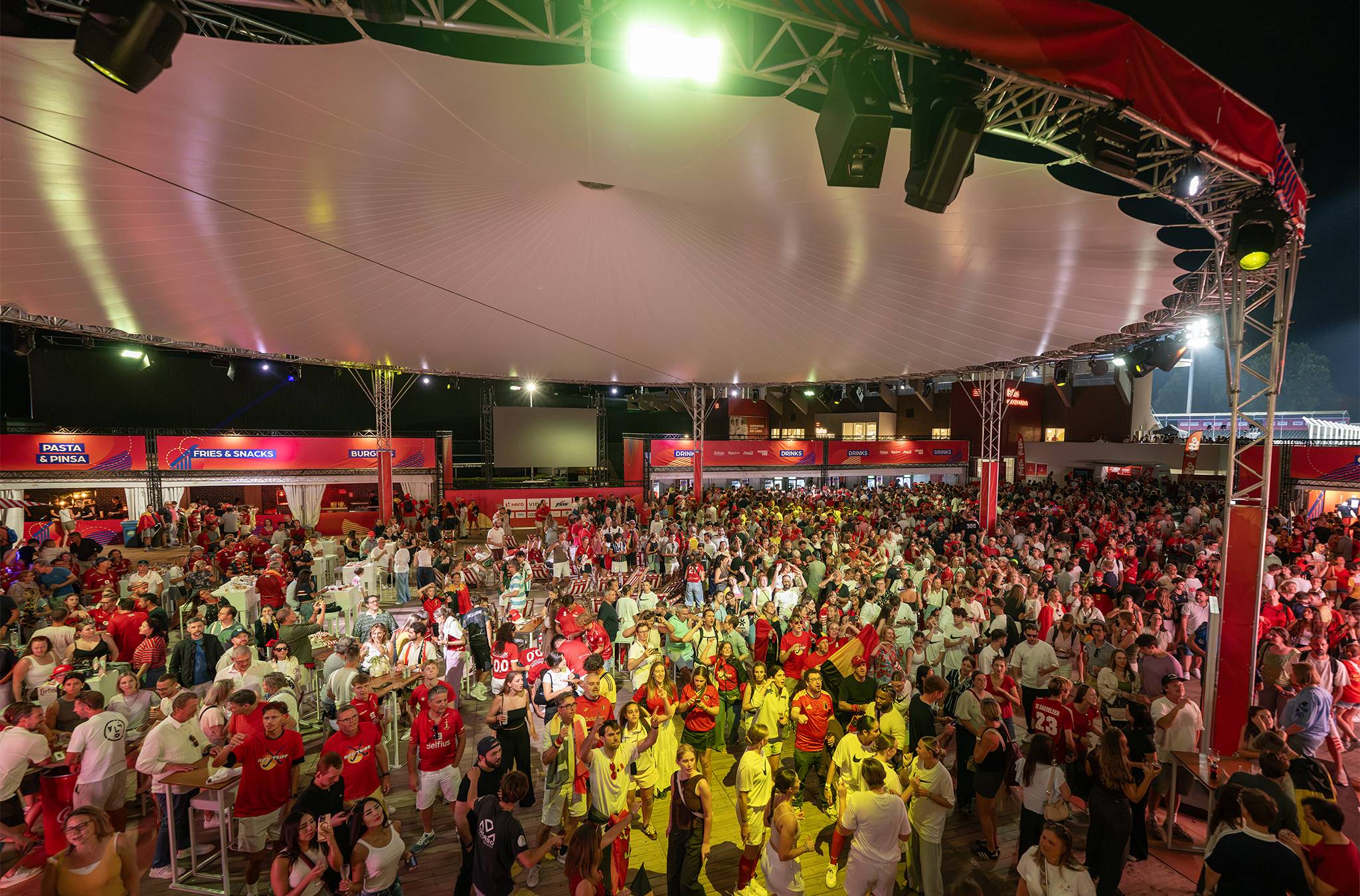
The event: a music club with concerts in its own hall, and big summer events outdoors.
The challenge: buying a large fleet of terminals would be "financially inefficient" for the club. Too few devices in summer means queues and lost revenue.
The setup: a fixed set of all-in-one terminals in the club. For the summer events, N9 rents extra mobile terminals for the outdoor terraces.
The result: N9 only pays for the extra devices when they actually generate revenue, says the customer story. The rest of the year, fixed costs stay low.
Also with Beyond Ordering: Coretec Dome, KapAlpen, Zomerbar Bloom and Brugge Plus.
Frequently asked questions
What does paying with Bancontact cost the customer?
Nothing extra: the merchant can't add a surcharge. What the customer pays their own bank for the card is a separate matter.
Is there a card terminal with no transaction fees?
Not at KBC, Mollie or SumUp: every card payment costs something there. Registering cash costs nothing at SumUp.
Can I rent a card terminal instead of buying one?
Yes, at some providers and banks. Then compare the monthly price over a full year with the purchase price.
When does the money reach my account?
Your provider decides. SumUp promises payout the next day at 7 am, weekends included.
Put your average bill next to three price lists
Take your till report for a normal month, divide your card revenue by the number of payments, and run the three formulas.
Want to see how payments and till work together in your venue? We'll show you in a 30-minute demo. Rather ask a question first? Get in touch.
Payments and till in one
In 30 minutes we'll show you how card, cash and QR end up in one report, with the payment partner that suits your venue.
Read more stories from our blog
Opening a summer bar: what do you sort out first?
Opening a summer bar starts in winter: first the site, then the KBO, FAVV, a drinks licence and a till that takes both cash and card.

Single-use cup ban in Belgium: which cups are still allowed in 2026?
The single-use cup ban in Belgium: what's still allowed at events, in your café and for takeaway? Flemish, federal and EU rules side by side.

Several bars in one venue: how do you track stock and sales per bar?
Running several bars in one venue? Track stock and sales per bar: each bar its own sales point, log transfers and count at closing against the report.