Open loop, closed loop or hybrid payments?
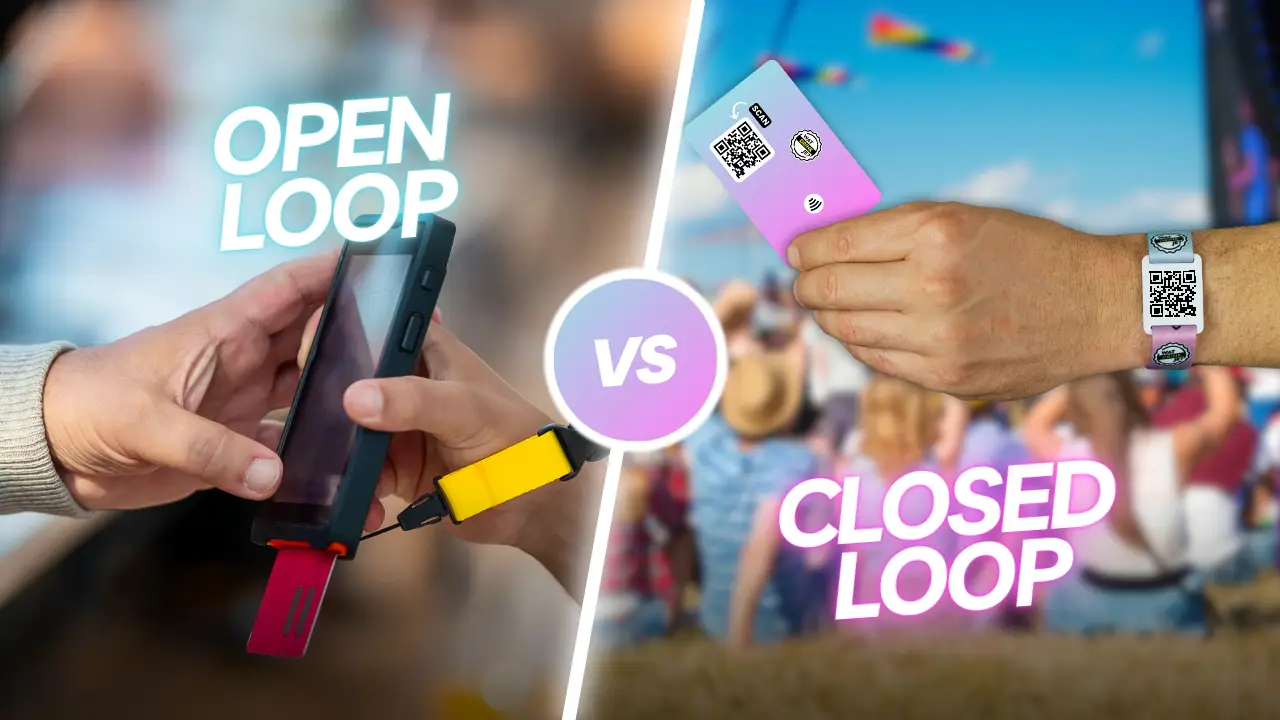
What is the difference between open loop and closed loop payments?
Whether you run a festival, a café or a sports club canteen: you want your guests to pay quickly and safely. You have three options: open loop, closed loop, or a hybrid combination of both. We compare them, with their pros and cons.
Closed loop payments
Closed loop is a closed payment system. Transactions are processed internally and are linked to one event, one venue or one organisation. The credit can't be used everywhere, only with you, or at several events of the same organiser.
Familiar examples are a cashless card or wristband that you top up in advance, a club card in the canteen or a QR voucher. Topping up works with one QR code on the carrier: through the Bancontact Pay app or your banking app, or through the wallet page with Apple Pay, Google Pay or card. It's also possible at the cash desk, by card or in cash.

Advantages of closed loop payments
- Control and management. You have full control over the money flows. The money comes in before anything is consumed.
- Convenient for your guests. Paying takes one tap with a card, wristband or voucher.
- Lower transaction costs. You only pay a transaction fee when topping up, not on every order.
- Fast and efficient. Because payments are processed internally, closed loop is the fastest way to settle. Ideal when it gets busy.
Disadvantages of closed loop payments
- Limited use. The credit can only be used with you.
- Entry threshold. Your guest first has to top up a card, wristband or voucher before ordering.
- Remaining balance. At the end, guests sometimes order less because they don’t want to top up again. Whatever is left, they can claim back online afterwards.
Open loop payments
With open loop, your guest pays with universal, external payment methods: Bancontact, Visa, Mastercard, Bancontact Pay, Apple Pay or Google Pay. These aren't tied to your event or venue, so they can be used anywhere.

Advantages of open loop payments
- Universal. Your guests pay the way they do every day. Everyone knows it.
- Order right away. Your guest doesn’t have to top up anything. That lowers the threshold for the first and for the extra order.
- No remaining balance. There is nothing to refund afterwards.
Disadvantages of open loop payments
- Transaction costs. Every payment is an external transaction with a transaction fee. With lots of small orders, that adds up.
- Fewer extras. Crew credits, presale credit or eco-tokens don’t work on a bank card.
Hybrid payment system
A hybrid payment system combines open and closed loop. A football club is a good example. Loyal supporters top up their club card and now and then get a little extra as a reward for their loyalty. Supporters of the visiting team only come by occasionally. They don't need an extra card: they simply pay with their bank card.
The same works in a café with regulars and passers-by, or at an event with season ticket holders and day visitors.
Advantages of a hybrid payment system
- Customer-friendly. Your guest chooses how to pay, without unnecessary steps.
- Efficient. With our all-in-one terminal you accept bank cards, Bancontact Pay and your own cashless card on one device.
Disadvantages of a hybrid payment system
- Two money flows. Open and closed loop each follow their own operational and financial route. With Beyond Ordering, they do come together in one platform and one report.

Conclusion
Closed loop, open loop or a mix of both: the right choice depends on your guests, how busy it gets and how much control you want. Not sure yet? We're happy to think along. Book a demo.
Read also: Closed-loop payments with Beyond Ordering
Read more stories from our blog
The ideal ordering and payment system for your club or association
Village fair, party or sports tournament? Here's how to tackle the three biggest challenges every club faces.

How a cashless payment system complements cash
Cash and cashless don't exclude each other. With cash cards and QR vouchers, everyone pays smoothly.
.webp)
VAT rates for Dutch events
Discover which VAT rates apply to food and drinks at your event in the Netherlands