How to organise a fuif: the bar, the till and no more drink tickets
To organise a fuif you need a date and a venue, a registration with your town if it asks for one, a music licence, a bar team with shifts, reusable cups and a way to take money.
That last choice decides what's left at the end. Drink tickets mean two queues and a cash count at 3 a.m. A cashless till removes the second queue and most of the count.
A fuif is the Flemish party a youth movement, student club or association throws to fund its year. The bar is where that money is made.
Our advice: let guests pay at the bar with a bank card or phone, and give cash payers a card they load at a cash point.
- Work back from the date: most of the work sits in the weeks before the fuif.
- Music in public needs a Unisono licence; your town decides the other formalities.
- Reusable cups are the rule at Flemish events, indoors too.
- Drink tickets are your own means of payment: guests must be able to buy them in cash and electronically.
- A cashless till gives you one queue and keeps crew drinks out of revenue.
How do you organise a fuif in five steps?
Work back from the date. Most of the work sits in the weeks before the night, not on the night itself.
Step 1: fix the date, the venue and the budget
Pick a date that doesn't clash with exams or another fuif in your area. Book the venue first; everything else follows from it.
There's no standard price for a fuif. The cost depends on a handful of drivers you can each ask a quote for:
- Venue: hall rent, cleaning, sometimes a deposit or a compulsory drinks supplier.
- Music: DJ or band, sound and light, and the Unisono licence.
- Safety: stewards or security, first aid, insurance.
- Bar: drinks stock, reusable cups and their washing, the deposit system.
- Till and payments: the number of terminals, how many nights you rent them, and how much on-site help you want.
Step 2: register the fuif, arrange music and check the rules
Many towns ask you to register a fuif well in advance, under a local fuif regulation. Ask your youth service early, because the deadline and the conditions differ per town.
Flanders points organisers to the ikorganiseer.be checklist for permits and liability (Vlaanderen.be on organising a fuif).
Playing music in public needs a licence from Unisono, the one desk for Sabam's copyright and the fair remuneration for performers and producers.
At the bar, no alcohol for anyone under 18, except beer and wine from 16. Beer with added spirits or a spirit flavour, and wine with added alcohol, stay 18+ (FOD Volksgezondheid).
Selling spirits for drinking on site at a public sports, cultural or political event? Federal law (art. 9, law of 28 December 1983) requires a special authorisation from the college van burgemeester en schepenen, as Ghent explains.
For a fuif, your town decides which formalities apply: ask your youth service.
Step 3: plan the bar and the cups
Plan your bar points for the peak, not for the average hour. Put the cup return next to the exit, not behind the bar.
Reusable cups are the rule at Flemish events, indoors too. Serving drinks in single-use containers is banned, apart from PET bottles and cans with 95% separate collection until 2030 (OVAM).
At least 90% of reusable cups must come back for reuse. Our post on reusable cups and deposits compares the deposit options.
Step 4: choose how people pay
This is the step a fuif often copies from last year: a ticket stand, a cash box and paper drink tickets.
It's also the step that decides how long people queue and how much you count afterwards. It's what we build as an ordering and payment system for clubs.
Step 5: close the night and settle
After the last round, count the cash, the cups and the stock. Pay what you owe and write down what you'd change.
The faster you can close, the sooner your volunteers go home.
In 30 minutes we'll show you how your bar volunteers sell, how cash payers get a card and what the report looks like at closing.
What do drink tickets cost you on the night?
Drink tickets cost you queues, cash and control.
Guests queue twice, once for tickets and once at the bar. The ticket stand becomes the bottleneck at the peak.
The cash box fills with notes and coins that someone has to guard, count and take to the bank. Tickets get lost, swapped or copied.
At closing, guests go home with tickets in their pocket, and you don't know what was really sold at which bar.
Crew drinks are the other leak. Free tickets for volunteers and bands end up in the same box as paid ones, so your figures rarely match the stock.
Which rules apply to drink tickets?
Paper drink tickets, tokens and cards are all your own means of payment in the eyes of FOD Economie. So the same rules apply to a fuif as to a festival with wristbands.
This is what the FOD Economie guidelines (2026) require for your ticket stand, and what they advise:
- Cash and card: if guests can buy tickets on site, they must be able to buy them in cash and electronically, with no surcharge on either.
- Prices in euro: your price list must show euro. A conversion table can do if the sums stay simple, but a euro price next to every ticket price is the advised practice.
- Say what happens to leftovers: tell guests before they buy a ticket whether unused drink tickets are refunded. A refund isn't compulsory. Without one, tell guests whether they can spend it all on the night; FOD Economie advises making sure they can.
- Keep any refund fee small: FOD Economie advises charging no more than your own cost, and at most the price of one soft drink at the event.
Do these rules apply to a youth movement too?
They bind every organiser with a lasting economic activity. The Code of Economic Law (art. I.8, 39°) counts every person or legal person with a lasting economic goal, and FOD Economie names associations.
No official source says whether a single fuif by a small youth group counts. Working this way is the safest choice.
What are three ways to run the till at a fuif?
You don't have to jump from paper tickets to wristbands in one go. These are the three routes we see, from the smallest step to the full switch.
| Paper tickets or tokens | Tokens, registered in software | Cashless: card at the bar, cash card for the rest | |
|---|---|---|---|
| How guests pay | Buy tickets at a stand, pay the bar in tickets | Same as now; the bar registers each sale on a terminal | Bank card or phone straight at the bar; cash payers load a card |
| Queues | Two: ticket stand and bar | Two | One: the bar |
| Cash to count | All revenue | All revenue | Only the cash top-ups |
| Leftover value | Tickets in pockets, no record | Recorded | Balance on the card, refund possible |
| Crew drinks | Free tickets, mixed with paid ones | Registered apart | Internal credit, kept out of revenue |
| What you know at closing | What's in the box | Sales per product and bar | Sales, stock and credit, live |
| Fits when | A small fuif with a tiny budget | You want data first, change for guests later | Most guests pay by card and you want one queue |
The middle route is how 12 Inch Lovers started at its indoor parties: tokens stayed at the bar while the software counted everything in euro. Later it moved to cashless cards.
That works for one night too: the ordering software registers cash and your own tokens next to card payments.
How does the night run without drink tickets?
Without tickets, the night has one queue and no cash box next to the bar. This is how the hours go:
- Before doors: the terminals arrive with your price list loaded. Each bar is its own sales point.
- Doors open: most guests walk straight to the bar and tap a bank card or phone. A small cash point loads a card for the few who bring notes.
- The peak: bar volunteers tap one button per drink. There's no change to give and nothing to tear off.
- Happy hour: a 2+1 on one beer runs from the time you set, then switches off by itself.
- Last round: you see on a phone which bar is running out of cups or stock, and move them.
- Closing: the report splits revenue per bar and crew credit. Only the cash top-ups need counting.
The software works with preset price lists, so a first-timer can serve after a short briefing.
How many terminals do you need?
Count the terminals from your bar: one per person serving at the peak, plus one at the entrance or cash point if you sell cashless cards.
A one-night rental is a normal short-term booking. Book early enough to pay the advance at least a week before delivery.
Remote and WhatsApp support during the fuif is standard; someone on site is agreed in the quote. Our service levels range from doing it yourself to our team on site.
How do you handle crew drinks without crew tickets?
Give volunteers, the DJ and the band a card with internal credit instead of free tickets. What they drink is registered, but it doesn't count as revenue.
You decide how much credit each person gets. Your stock count stays right, and the treasurer sees crew drinks apart from sales.
Whether your youth movement or vzw charges VAT on bar sales, or falls under an exemption, is a question for your accountant. See also is a vzw liable for VAT?
Our post on the order and payment system for associations covers the same tools for a village fair or a sports tournament.
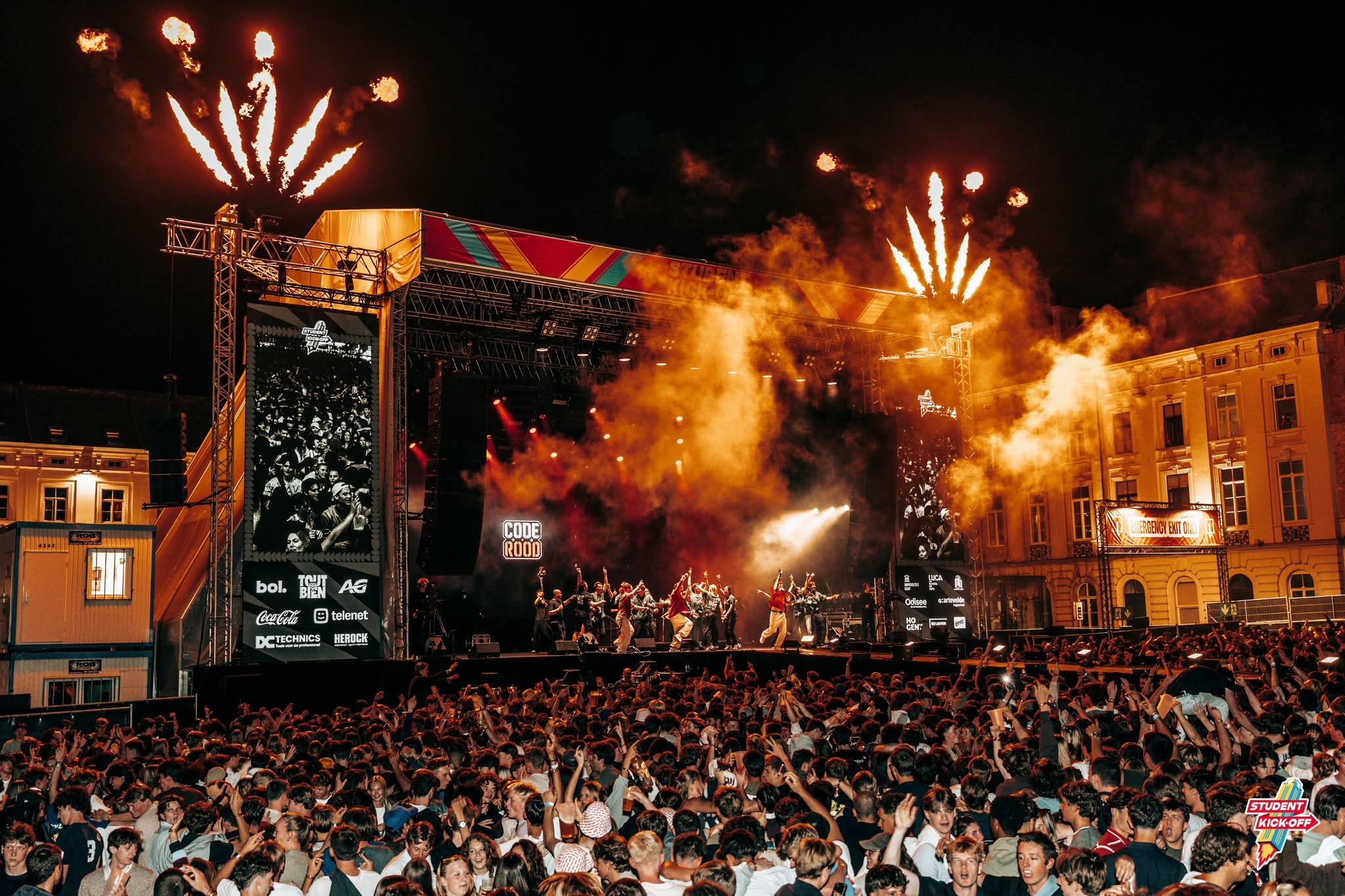
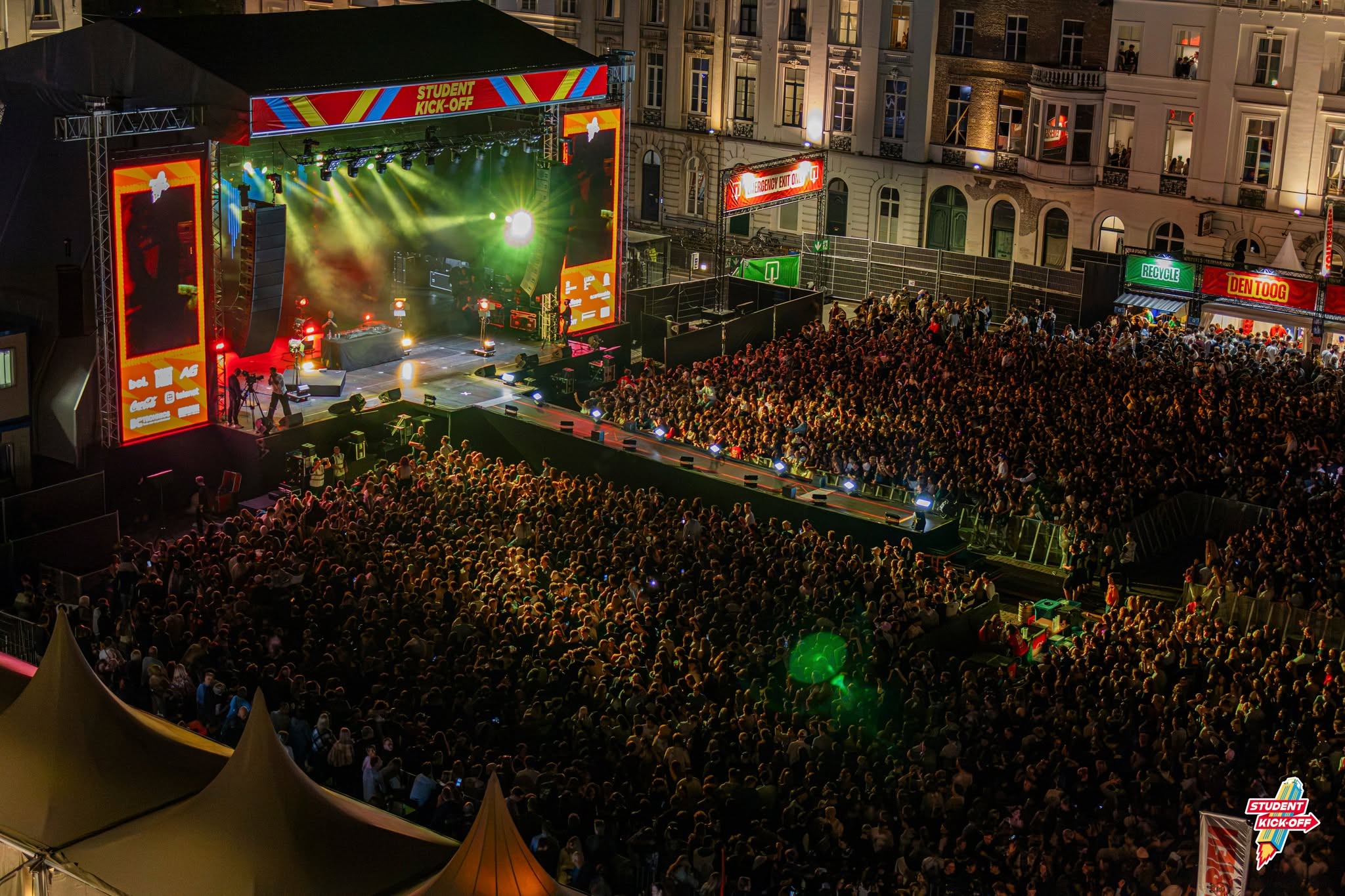
Organising a festival for 35,000 students in the centre of Ghent made me hesitant about going cashless. But thanks to Beyond Ordering’s involvement and guidance, the switch went remarkably smoothly. They never push anything, they think along with our organisation, and they’re always available, before, during and after the event. Two years in, we’re still just as happy: a huge asset for our F&B operation and for our visitors.

In practice: Student Kick-off Gent
The event: Student Kick-off Gent is far bigger than a fuif: 35,000 students on the Sint-Pietersplein in one evening.
The challenge: the problem is the same, though. One night, a student crowd, and the bar has to carry the night. Between 20:00 and 00:30 every bar ran at full speed, and a slow or faltering payment system wasn't an option.
The setup:
- One queue: most students paid at the bar with a bank card, Apple Pay or Google Pay, without topping up.
- Cash without tickets: the few who paid cash loaded a personal cashless card at central cash points. Friend groups often used one card as a shared pot.
- Promotions: timed 2+1, 1+1 and 3+1 deals, programmed in advance, switched on and off by themselves.
- Hardware: 85 mobile terminals, 75% of them contactless only, plus 20 terminals on stands, with our full service.
The result: as the story puts it, students paid quickly, even at the peak. The organisation ran its promotions and cup swap at no extra cost.
Also running on Beyond Ordering: 12 Inch Lovers at its indoor parties.
Checklist for the night itself
Print this and tape it behind the bar.
- Registration with the town (if it asks for one), Unisono licence and insurance papers at hand.
- Price list in euro on every bar, the same as on the terminals.
- A cash point for guests without a card, with change for the first hour.
- Terminals charged, one spare per bar.
- Crew credit loaded and handed out before doors open.
- Cup return point next to the exit, with someone on it from the last round.
- One person who watches stock and cups per bar during the night.
- Closing: report pulled, cash top-ups counted, cups counted against the 90% target.
Frequently asked questions
What are good alternatives to drink tickets at a party?
Let guests pay at the bar with a bank card or phone, and give cash payers a card they load at a cash point.
If that's too big a step, keep tokens for one more edition and register every sale in software.
Which permits do you need for a fuif?
A registration or permit if your town's fuif regulation asks for one, and a Unisono licence for the music.
Selling spirits for drinking on site at a public sports, cultural or political event? Federal law requires a special authorisation from the college. For a fuif, your town decides which formalities apply. The ikorganiseer.be checklist, which Vlaanderen.be points to, lists the rest.
How much does it cost to organise a fuif?
It depends on the venue, the music, safety, the bar and the till. Ask a quote for each driver separately and compare.
A fuif mostly pays for itself at the bar, so a faster bar is worth weighing against its cost.
Can a fuif refuse cash?
Not if these rules apply to you, and the safe choice is to assume they do. Guests must be able to pay in cash and with at least one electronic means, also when they buy your tickets or load your card.
What happens to drink tickets guests don't use?
That's up to you, but you must tell guests before they buy. Without a refund, say whether they can spend everything on the night. FOD Economie advises making sure they can.
Run your next fuif with one queue
Tell us your date, your venue and how many guests you expect.
In a 30-minute demo we show how your bar volunteers sell, how cash payers get a card and what the report looks like at closing. Rather ask a question first? Get in touch.
One queue at your fuif
In 30 minutes we'll show you how your bar works without drink tickets, how cash payers load a card and what the report looks like at closing.
Read more stories from our blog
Ordering via QR code in your bar or restaurant: how it works
Guests scan, order and pay upfront on their phone, and the order goes to the bar or kitchen. How it works, with the GKS rule and a summer bar.

Hospitality VAT in Belgium: which rate for your café or restaurant?
Hospitality VAT in Belgium: 12% on served food, 21% on every drink you serve, 6% on food and soft drinks to take away. With a worked bill.
Cashless festival: how it works from top-up to refund
How a cashless festival runs on the day: top-up points, the bar, crew credit, cups, closing time and refunds, seen from the organiser and the crew.